Showing posts with label Low Budget PPC. Show all posts

Wednesday, 7 May 2014

The Three First Important Steps Towards Generating Advertising Revenue On Your Website.


It's a common dream to want to build a website, have an extensive amount of website traffic and rake in advertising revenue whilst relaxing on a beach - but an unrealistic one for most people and businesses.

If a startup wants to get the attention of investors, it needs to show large growth - we're talking like $50 million revenue in a five year period. Today, without highly specialised targetting, the rule-of-thumb expectation should be no more than $1 in advertising revenue per 1000 page views. 

Bar Chart Showing Facebook User Growth From 2004-2012


To get to $50 million in revenue you would need 50 billion page views in a year, or just over 4 billion per month. To give you an idea in principal, Facebook now has over 1 trillion page views and has been profitable only in the last four years, and thats with hundreds of millions in funding!

Before I get into the ways in which to generate ad revenue, let me state the obvious:

  • Higher priced products and larger organisations can afford to pay more for advertising than low-priced products and smaller organisations.
  • Only targetted advertising will ever be clicked on. If you put a fast food banner onto a fitness website, you won't sell much excitement or interest.
  • Advertising is priced on supply and demand. Right now there is an unlimited supply of web pages on the internet, but if your site does not have a valuable target audience then you will not be noticed by advertisers.
# Now lets look at the first three steps for generating advertising revenue..

A website owners most valuable asset is the websites audience. Remember, advertisers buy audiences, not adspace. 

# Provide High Quality Content

Advertisers will only pay you for advertising if it helps them make money. To make them money, your website needs regular visitors. To get regular visitors, you need to generate unique and relevant content to engage with consumers so they regularly come back to the website for more.

The best way to publish unique and relevant content is through a blog!

You can view my blog post about the best free blogging platforms by clicking here.

# Optimising Your Content With Keywords

Before posting and showing off all the unique content you've created, you need to optimise your content around high-priced keywords. You can use Google AdWords Keyword Planner to find out what keywords get the highest bids in your niche.

Keyword Optimisation needs to be completed in two primary ways:
  1. Keyword Focus: Select 10-20 of the highest priced keywords for your industry, then write content about these topics. 
  2. Keyword Placement: Where appropriate, put these high priced keywords into title tags, subheadings, photo tags, filenames for graphics and in the first and last paragraph.
Having great content is not enough, you want to focus your efforts on the most profitable topics that will attract greater traffic to your site.

Learn how to optimise your content here.

# Generating Traffic

It goes without saying that a lack of traffic to your website will not generate much advertising revenue. If you want to attract advertisers, you need to make yourself available. This includes using sound SEO principles to rank well on search engines.

You can read the beginners guide to SEO here.

Another key part of generating traffic is demonstrated through successful link building. Get links and recommendations to your website from other sites, blogs, social media sites and directories.

You can read the beginners guide to link building here.

The final option for generating traffic is paying for advertising to get people onto your website. If you were to try and sell directly to advertisers, the first question they would ask you would be about the number of monthly unique visitors and pageviews on your website. Unless you have healthy numbers that makes advertising on your site worth it, they wont bother. Google Adwords is a good place to start and options are available for startups, SME's and large organisations.

You can read my blog about why your small business should be using Google AdWords to increase profits here.

References

 
Heng, C. (2014). How to Make Money From Your Website through Affiliate Programs (thesitewizard.com). [online] Thesitewizard.com. Available at: http://www.thesitewizard.com/archive/makemoney.shtml [Accessed 7 May. 2014].

Wiebesick, C. (2014). A Startup’s Guide to Generating Online Ad Revenue - 'Net Features - Website Magazine. [online] Websitemagazine.com. Available at: http://www.websitemagazine.com/content/blogs/posts/pages/Startup-Guide-to-Generating-Online-Ad-Revenue.aspx [Accessed 7 May. 2014].

Wilson, D. (2014). 8 Steps to Developing Ad Revenue from Your Website. [online] Available at: http://webmarketingtoday.com/articles/wilson-ad-revenue-4/ [Accessed 7 May. 2014].

Zwilling, M. (2012). Startup Professionals Musings: Website Ads are Not a Revenue Stream for Startups. [online] Blog.startupprofessionals.com. Available at: http://blog.startupprofessionals.com/2012/03/website-ads-are-not-revenue-stream-for.html [Accessed 7 May. 2014].

Monday, 5 May 2014

3 Reasons Why Your Small Business Should Be Using Google Adwords To Increase Profits


Websites exist on traffic, and countless organisations around the world spend a lot of time in making efforts to drive and increase traffic to their site. There are many ways to do this including Article submission, Blogging, Social Bookmarking and Social Networking to name a few, however Google AdWords is a very influential and effective method of improving traffic to a website. Here's why..

Google Adwords, Online Advertising
Google Adwords - Online Advertising

Google is the largest search engine on the Internet, and to use the Internet as a profit-making source, one needs to use Google. The more smartly you use it, the more benefits you will reap. Google AdWords makes your marketing task a whole lot easier by bringing huge per click traffic through the use of proper keywords.

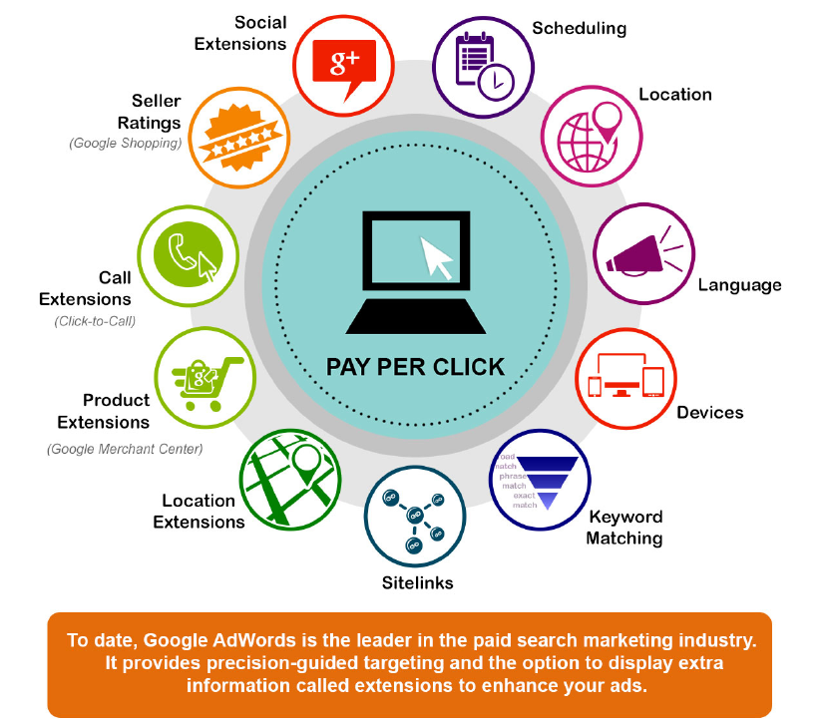
Infogram Showing Aspects Of PPC
Google PPC Campaign

Google AdWords is the main advertisement and major revenue source for Google. It offers a Pay Per Click (PPC) advertising campaign that includes ad programs with local, national, and international distribution. Google AdWords offers assured, immediate traffic to Web sites against a certain investment, and therefore using this campaign comes with a host of advantages for Web sites and businesses. 

#1. The Ability To Target Certain Locations

Google AdWords location targeting enhances the importance of a campaign all the more. Location targeting is one of the most important and useful components of implementing a successful PPC campaign. This determines in which location a particular ad campaign will be shown and thus one can customize ad displays per location. It also disables locations where the ads need not be displayed.

How To Target Locations Using Google AdWords
AdWords Location Targetting
Depending on your target market, you may only want to show ads to searchers from certain areas of the country. For example, if you run a local restaurant you don't want your ads showing up nationally. Simply tell Google to show your ads only to searchers in a certain geographic region.

As a company policy, Google does not disclose the performance of other companies that may have the same service or product as yours. So, this means you cannot compare your AdWords campaigns to other companies, so benchmarking is difficult. As a result, advertising strategies on Google Adwords still have to be well planned to garner and effective response from the consumer - not ideal for smaller firms with no experience of using Google AdWords.

Find a complete guide to AdWords Geotargetting & Local PPC Here

#2. Small Initial Investment

The main reason for the importance and popularity of Google AdWords is its small initial investment. You need to pay only a small amount to create an AdWords account; thereafter you can bid on the best keywords. After creating the Google AdWords account and releasing the content, the payment is billed after every click. Therefore, with each click, a certain amount is billed and if no click happens, no amount is billed. In such a case, Google AdWords comes with assured clicks, and payment is billed only against clicks. Furthermore, Google AdWords comes with a Return of Investment (ROI). This means you need to pay Google per click, which suggests your investment is returned against assured business.

However, it is important to note that every click to the company website is a charge to the company – even if the visitor makes a purchase or not from the site. Depending on the product, sometimes your visitors can be varied ranging from your competition to researchers, so the amount you pay for Google AdWords ultimately depends on the type of visitors your website attracts.

Find out how to manage your Google AdWords costs here

Learn how to manage a low budget Google AdWords campaign here

#3. Keyword Matching

Google supports four "match types" and not only can you add any relevant keyword to your campaigns and AdGroups, you can set them up to show in particular instances.
  • Broad Match: This is a default option in which search engines match your ad against a keyword and related terms. The impact is that the keyword you've selected is now automatically being matched against a broad array of related queries. This option lets you pick a term related to your business, and attempts to discover other terms that search engines deem relevant to match your ad to. 
  • Phrase Match: If you place quotation marks around your keyword your ad may be shown when someone searches the exact phrase in that exact order, possibly with words added before or after. This is the best way to drive qualified traffic to your site for a variety of related keywords without having to add every keyword imaginable to the campaign using exact match.
  • Exact Match: If you place brackets around your keyword your ad will only be shown when a query is made for that specific phrase, no words before or after. This type of matching should be used sparingly, as it adds time to your setup. You'll need to include every phrase possible to be sure your ads are showing
  • Negative Match: Negative keyword matching eliminates your keyword from showing up in irrelevant queries. For example, if you have the phrase-matched keyword "Hedge Cutters" in your campaign but you don't sell steel hedge cutters, you could set up the negative keyword "steel hedge cutters." This keeps your ad from showing for queries that don't convert.
Finally, at the minimum, the copy space for Adwords is 70 characters only so choose your words carefully for maximum effect.
Find out how to optimally use keyword match types for adwords success here

#.References  

Hill, C. (2008). 4 Ways Google AdWords Can Increase Small Business Profits. Available: http://searchenginewatch.com/article/2064205/4-Ways-Google-AdWords-Can-Increase-Small-Business-Profits. Last accessed 5th May 2014.

Lolk, A. (2013). 6 Ways To Optimally Use Keyword Match Types for AdWords Success. Available: http://www.searchenginejournal.com/6-ways-to-optimally-use-keyword-match-types-for-adwords-success/64888/. Last accessed 5th May 2014.

Raehsler, L. (2013). Google AdWords Keyword Match Types and Negatives: The Ultimate Guide. Available: http://searchenginewatch.com/article/2274277/Google-AdWords-Keyword-Match-Types-and-Negatives-The-Ultimate-Guide. Last accessed 5th May 2014.

Saleem, N. (2012). 10 Reasons Why You Should Be Using Google AdWords. Available: http://www.instantshift.com/2012/05/30/10-reasons-why-you-should-be-using-google-adwords/. Last accessed 5th May 2014.